

Israeli Jews: Region History
Israeli Jews are among the most internally diverse national populations on earth — a people unified by religious tradition, historical memory, and political project while divided by origin, culture, language, religious observance, and political conviction in ways that defy easy summary. They trace their roots to every corner of the diaspora: Ashkenazim from Eastern Europe, Mizrahim from the Arab world and Persia, Sephardim from Iberia and the Mediterranean, Ethiopians, Yemenites, and immigrants from over a hundred countries who have converged in a single small state over less than a century. To understand Israeli Jewish society is to understand a people shaped simultaneously by one of history's most sustained experiences of persecution and by the profound moral and political complexities of statehood, occupation, and contested sovereignty in one of the world's most disputed territories.
Part I — Historical Foundations
Ancient Origins, Diaspora, and the Long Memory of Exile
Jewish civilization originated in the ancient Near East in the second millennium BCE, developing from the Canaanite and Semitic cultural matrix of the southern Levant into a distinctive religious and ethnic community defined by monotheistic theology, covenantal law, and a relationship to a specific land — known variously as Canaan, Israel, Judah, and later Palestine — that has persisted in religious consciousness and collective memory across three thousand years. The Hebrew Bible records the formative narratives of this community: the Exodus from Egypt, the revelation at Sinai, the establishment of the Davidic monarchy, the construction and destruction of the Temples in Jerusalem, and the Babylonian exile of the sixth century BCE that initiated the first major diaspora.
The destruction of the Second Temple in 70 CE by Roman forces and the subsequent suppression of the Bar Kokhba revolt in 135 CE accelerated the dispersal of the Jewish population from the Land of Israel into communities across the Roman Empire and beyond — a process that would over subsequent centuries produce Jewish populations in Babylon (modern Iraq), Persia (modern Iran), Egypt, North Africa, the Arabian Peninsula, Spain, France, the Rhine Valley, Poland, and eventually virtually every inhabited region of the globe. Each diaspora community developed its own distinct cultural synthesis, adapting local languages, legal traditions, and material culture while maintaining the core frameworks of halakha, liturgy, and a yearning for return to Zion expressed in daily prayer.
Persecution in the European Diaspora
The history of Ashkenazi Jewry — the communities of Central and Eastern Europe who would provide the majority of Israel's early founders — is inseparable from the history of anti-Jewish persecution on the European continent. Beginning with the massacres of the Crusade period in the eleventh and twelfth centuries, through the expulsion from England (1290), France (1306), and Spain (1492), the blood libel accusations and associated pogroms that recurred across the medieval and early modern periods, the mass violence of the Khmelnytsky Uprising in seventeenth-century Ukraine, and the systematic pogroms of the Russian Empire in the nineteenth and early twentieth centuries, Jewish communities in Europe lived under conditions of legal discrimination, forced residential segregation, periodic mass violence, and existential vulnerability that shaped both their religious culture and their political consciousness.
The Enlightenment and the emancipation movements of the eighteenth and nineteenth centuries opened a period of dramatic transformation for European Jews, as legal barriers to civic participation were progressively dismantled in Western Europe and opportunities for integration, secular education, and professional advancement expanded. Yet emancipation also produced its own complexities — the expectations of cultural assimilation, the emergence of racial antisemitism as a pseudoscientific ideology distinct from older religious anti-Judaism, and the reassertion of violent exclusion even in supposedly emancipated societies, culminating in the Dreyfus Affair in France and the institutionalized antisemitism of the Austro-Hungarian and Russian empires.
Zionism and the Project of Return
It was in this context of European antisemitism, failed emancipation, and persistent diaspora vulnerability that the Zionist movement emerged in the late nineteenth century as a political response to what its founders characterized as the insolubility of the Jewish question within European society. Theodor Herzl, a Viennese Jewish journalist whose encounter with French antisemitism during the Dreyfus trial crystallized his convictions, published Der Judenstaat (The Jewish State) in 1896 and convened the First Zionist Congress in Basel in 1897, launching a political movement that would within fifty years produce a Jewish state in the Land of Israel.
Zionism was not a monolithic movement — it encompassed labor socialists, liberal nationalists, religious messianists, cultural autonomists, and territorial pragmatists who disagreed profoundly about the character of the proposed state, the role of religion, the relationship to the Arab population already living in Ottoman and later British-controlled Palestine, and whether the Land of Israel was the only acceptable location for Jewish national renewal. These internal tensions — between secular and religious, socialist and capitalist, hawkish and dovish, Ashkenazi and Mizrahi — have defined Israeli Jewish political culture from the state's founding to the present day.
The Jews are not a race but a people — a people formed by history, held together by law, memory, and the sense that their fate is shared. That sense of shared fate is older than any nation-state and will outlast whatever political arrangements the present produces.
— Simon Dubnow, historian, writing in the 1920sThe Shoah and the Birth of Israel
The Holocaust — the systematic, state-organized murder of approximately six million Jews by Nazi Germany and its collaborators between 1941 and 1945 — represents the defining catastrophe of modern Jewish history and the event that most immediately shaped the conditions of Israel's founding. The genocide was not merely unprecedented in scale; it was unprecedented in its industrial organization, its ideological totality, and its explicit aim of eliminating every Jewish man, woman, and child in Europe. It was carried out not in the medieval darkness of religious fanaticism but in the heart of twentieth-century Europe, by a modern state using modern bureaucratic and technological means, in a continent where Jewish emancipation had been underway for over a century.
The Holocaust destroyed approximately one-third of the world's Jewish population and virtually annihilated the Ashkenazi cultural world of Eastern Europe — the Yiddish-speaking civilization of Poland, Lithuania, Ukraine, and the Russian Pale of Settlement that had produced the majority of Zionism's founders and would-be pioneers. The shtetlakh, the yeshivot, the Bundist labor movements, the Yiddish theaters and newspapers and novelists — all of it was systematically destroyed. The surviving remnant, displaced in European DP camps and unable to return to communities that had been erased, provided the urgent demographic and moral impetus for the establishment of a Jewish state that could not be denied to its surviving population.
Statehood, War, and the Palestinian Nakba
Israel declared independence on May 14, 1948, the day before the expiration of the British Mandate for Palestine. The declaration was met with immediate invasion by the armies of Egypt, Transjordan, Syria, Iraq, and Lebanon, initiating the 1948 Arab-Israeli War — known in Israeli memory as the War of Independence and in Palestinian memory as the Nakba (catastrophe). The war ended with Israeli control of significantly more territory than the UN partition plan had allocated to the Jewish state, the displacement of approximately 700,000 Palestinian Arabs who became refugees, and the beginning of the Israeli-Palestinian conflict's most intractable phase.
The founding of Israel thus carried within it from the outset a profound moral and political complexity that Israeli Jewish society has never fully resolved: the realization of the Zionist project of Jewish self-determination and refuge — a project rooted in genuine historical necessity and the memory of persecution — occurred in the same historical moment as the displacement of another people from the same land, creating a layered injustice whose consequences continue to define the political reality of the region and the moral landscape of Israeli Jewish identity.
Part III — Communities Within a Community
Israeli Jewish Communities: An Ethnic & Cultural Encyclopedia
Israeli Jewish society is not a single community but a mosaic of distinct ethnic, cultural, and religious traditions that have converged in the State of Israel from across the global diaspora. The entries below document the principal communities that constitute Israeli Jewish society — their origins, languages, cultural traditions, religious practices, and their place within the social and political hierarchies of the Israeli state. Understanding this internal diversity is essential to understanding both Israeli society's extraordinary vitality and the fault lines along which its political and social tensions run.
Ashkenazi Jews — those whose ancestors came from the Jewish communities of Central and Eastern Europe — were the dominant founding group of the Zionist movement and the early Israeli state, and their cultural, political, and institutional imprint on Israeli society remains profound. The early Zionist pioneers (halutzim) who drained swamps, established kibbutzim, built the Histadrut labor federation, and fought in the Haganah were overwhelmingly Ashkenazi, and the social democratic Labor Zionism they championed shaped the foundational institutions of the Israeli state. The Hebrew language itself, as revived by Eliezer Ben-Yehuda and standardized for use in the new state, drew heavily on the Eastern European Ashkenazi pronunciation that became standard Israeli Hebrew.
Ashkenazi cultural life in Israel has been shaped by two foundational experiences: the secular socialist idealism of early Zionism, which often sought to create a "new Jew" explicitly opposed to the perceived passivity and religious traditionalism of diaspora life, and the trauma of the Holocaust, which devastated the Eastern European communities from which most Ashkenazi Israelis descended. The tension between these two poles — revolutionary optimism and catastrophic loss — runs through Ashkenazi Israeli culture in literature, film, politics, and religious life.
Mizrahi Jews — those whose ancestors came from the Jewish communities of the Middle East, North Africa, and Central Asia — constitute the largest ethnic bloc in Israeli Jewish society today, particularly when mixed Ashkenazi-Mizrahi Israelis are included. Their immigration to Israel occurred primarily in the 1950s and 1960s, following the establishment of the state and the subsequent deterioration of conditions for Jewish communities in Arab countries — driven by a combination of antisemitic violence, legal discrimination, property confiscation, and the political pressures produced by the Arab-Israeli conflict. Communities that had existed in Iraq, Yemen, Morocco, Libya, Egypt, and Syria for hundreds or in some cases over two thousand years were uprooted within a generation.
Mizrahi cultural life is extraordinarily diverse — the Yemenite Jewish tradition, with its distinctive liturgical poetry and chant, is as different from Iraqi Jewish culture as either is from Moroccan Jewish practice. What Mizrahi communities share is a heritage of living as Jewish minorities within Arab and Persian Muslim societies — an experience that produced its own distinctive synthesis of Hebrew, Arabic, and local cultural elements, its own legal traditions within the broad Sephardic halakhic framework, and its own relationship to the surrounding culture that was neither the segregated ghetto experience of Eastern Europe nor the assimilationist striving of Western Jewry.
In the strict historical sense, "Sephardim" refers specifically to the descendants of Jews expelled from Spain and Portugal in 1492 and 1497 — the largest forced expulsion of Jews in history before the Holocaust, affecting an estimated 200,000–300,000 people. These exiles dispersed across the Ottoman Empire — settling in Constantinople, Salonika, Izmir, Jerusalem, Safed, and Cairo — as well as into North Africa, the Netherlands, and the Caribbean, carrying with them their Castilian Spanish language (which evolved into Ladino, or Judeo-Spanish), their distinctive liturgical traditions, and an extraordinary cultural heritage accumulated over centuries of Iberian life.
Salonikan Sephardic Jewry — the largest Jewish community in any city in the world at the turn of the twentieth century — was virtually annihilated in the Holocaust, with 96% of the community's approximately 50,000 Jews deported to Auschwitz and killed between March and August 1943. This loss devastated the Ladino-speaking world irreversibly. The Ladino language itself is now critically endangered, with active speakers concentrated primarily among elderly Israelis of Turkish or Balkan origin and small diaspora communities in Turkey, Greece, and the Americas.
Beta Israel — Ethiopian Jews — are among the most remarkable communities in the Jewish world, having maintained a distinctive form of Jewish practice in the Ethiopian highlands for at least fifteen centuries in near-complete isolation from the rabbinic Jewish traditions of the rest of the diaspora. Their religious practice is based on the Orit — their version of the Hebrew Bible in Ge'ez translation — rather than the Talmud, and is led by Kesim (singular: Kes), hereditary priests distinct from the rabbinic tradition. Their observances reflect a form of Judaism preserved from a very early period, incorporating practices lost or transformed in the rest of the Jewish world.
Beta Israel were airlifted to Israel in two dramatic operations: Operation Moses (1984–85), which evacuated approximately 8,000 Ethiopian Jews during a famine, and Operation Solomon (1991), which airlifted 14,325 people in 36 hours as the Mengistu regime collapsed. These operations are celebrated in Israeli national memory as expressions of Jewish solidarity and the Law of Return. The reality of Ethiopian Jewish integration into Israeli society has been significantly more painful: Ethiopian Israelis face documented discrimination in education, housing, employment, and policing, and have organized some of Israel's most significant domestic civil rights protests.
Yemenite Jews trace their presence in the Arabian Peninsula to before the destruction of the Second Temple — a claim supported by the distinctiveness of their Hebrew pronunciation, liturgical tradition, and legal customs, which preserve features lost elsewhere in the Jewish world. They lived for centuries as dhimmis under Zaydi Imamate rule in Yemen, subject to periodic discrimination and violence but maintaining a rich intellectual and religious culture centered on Torah study, poetry, and the distinctive Baladi liturgical tradition. The catastrophic Mawza Exile of 1679 — in which the Imam expelled Yemen's entire Jewish population to a malarial coastal region — killed thousands and left an indelible mark on Yemenite Jewish collective memory.
Operation Magic Carpet (1949–1950) airlifted nearly 50,000 Yemenite Jews to Israel — the vast majority of the community — in an operation many participants described in quasi-messianic terms, fulfilling the ancient prayer for return. Yemenite Jews have contributed enormously to Israeli culture, particularly in music: the distinctive Yemenite vocal tradition, with its microtonal ornamentation and ancient melodic structures, has profoundly influenced Israeli popular music through figures including Shoshana Damari, Ofra Haza, and A-WA.
The mass immigration of Jews from the former Soviet Union — primarily between 1990 and 2001, with over one million people arriving in a decade — represents the largest single wave of immigration in Israeli history and one of the most dramatic demographic transformations of any country in the modern era. This aliyah was triggered by the collapse of the Soviet Union, the lifting of emigration restrictions, the outbreak of antisemitic violence in several former Soviet states, and Israel's active encouragement of immigration under the Law of Return, which extends Israeli citizenship to anyone with at least one Jewish grandparent.
Russian-speaking Israelis are a highly educated community — Soviet Jews had access to scientific and technical university education despite anti-Jewish quotas, and the immigration wave brought an extraordinary concentration of engineers, scientists, doctors, musicians, and academics. Israel's high-tech sector was significantly catalyzed by this influx of technical talent. Russian-speaking Israelis have formed a distinct cultural community within Israel, maintaining Russian-language media, theater, and cultural institutions that constitute a parallel civil society operating largely independently of Hebrew-language Israel.
Haredi (literally "those who tremble before God") Jews are the fastest-growing sector of Israeli Jewish society, with a birth rate roughly three times the national average and a community that demographers project will constitute 20–25% of Israeli Jews by mid-century. They live in largely self-contained communities — primarily in Jerusalem's Mea Shearim and Geula neighborhoods, in the city of Bnei Brak near Tel Aviv, and in a growing number of satellite cities — governed by the authority of rabbinic leaders (gedolim) whose decisions on matters of law, politics, and daily life carry binding authority within their communities.
Haredi society is internally diverse, divided between Hasidic dynasties (Ger, Belz, Vizhnitz, Satmar, and dozens of others) and the non-Hasidic Litvak (Lithuanian) yeshiva tradition, as well as between Ashkenazi Haredi and the Sephardic Haredi community organized around the Shas political party. What unites them is commitment to full-time Torah study as the highest male vocation, separation from secular Israeli culture, Yiddish as the home language, and a rejection of the secular Zionist project as a form of premature Jewish nationalism that usurps the divine prerogative of messianic redemption — a theological position that coexists uneasily with the practical fact of living within and benefiting from the Israeli state.
Secular (hiloni) Israelis — those who self-identify as non-observant — constitute the plurality of Israeli Jewish society and the backbone of its professional, military, academic, and high-technology sectors. Secular Israeli culture is in many respects a genuine civilization in its own right: a Hebrew-speaking, Mediterranean-inflected, technologically sophisticated society with its own literature, cinema, music, humor, cuisine, and political traditions that are distinct from both diaspora Jewish culture and from the religious traditions of the Orthodox communities. Israeli Hebrew — a revived ancient language layered with Arabic, Yiddish, Russian, and English influences — is the vernacular of this culture and represents one of the most extraordinary linguistic achievements in modern history.
The secular Israeli relationship to Jewish identity is complex: most hilonim observe Passover seders, light Hanukkah candles, fast on Yom Kippur, and feel a strong emotional connection to Jewish history and collective memory — but reject the authority of the Orthodox rabbinate over their personal and civic lives. The inability to conduct civil marriages in Israel — where all marriages must be performed under religious auspices — is among the most concrete grievances of secular Israelis, who may travel to Cyprus or elsewhere to marry in civil ceremonies the Israeli state then recognizes.
Appendix — Historical Persecution
Crimes Against the Jewish People: A Historical Record
The following section documents the principal categories of persecution, violence, and genocide directed against Jewish people across history and into the modern period. This record does not diminish or discount the suffering of other peoples. It exists because understanding the history of anti-Jewish persecution is essential to understanding the conditions that produced the Zionist movement, the State of Israel, and the security consciousness that shapes Israeli Jewish political culture. Entries draw on the historical record established by Yad Vashem, the United States Holocaust Memorial Museum, academic scholarship, and contemporary human rights documentation.
Pogroms — organized riots targeting Jewish communities, typically with government connivance or active participation — were a defining feature of Jewish life in the Russian Empire and Eastern Europe from the medieval period through the early twentieth century. The word itself, derived from Russian, entered global usage during the wave of anti-Jewish violence that swept the Pale of Settlement following the assassination of Tsar Alexander II in 1881 — an event blamed on Jewish revolutionaries despite their marginal involvement. The resulting pogroms drove approximately two million Jews to emigrate from the Russian Empire between 1881 and 1914, the majority to the United States and a significant minority toward Palestine.
Pogroms were not spontaneous expressions of popular hatred — they were typically organized, often with lists of Jewish homes and businesses prepared in advance, conducted with military or police standing by while crowds killed, raped, and looted, and followed by official investigations that prosecuted victims rather than perpetrators. This pattern of state-orchestrated communal violence established the logic that would eventually convince Herzl and successive Zionist thinkers that Jewish security could not be achieved within European states.
The expulsion of Jewish communities from European kingdoms was among the most commonly employed instruments of anti-Jewish persecution in the medieval and early modern periods. Jews were expelled from England in 1290, France in 1306 and again in 1394, numerous German principalities across the fourteenth and fifteenth centuries, Portugal in 1497, and most catastrophically from Spain in 1492 — the Alhambra Decree that expelled 200,000–300,000 Jews from the Iberian Peninsula at three months' notice, forcing the abandonment of properties, businesses, and communities that had existed for centuries. These expulsions were rarely spontaneous: they typically followed periods of escalating legal discrimination, blood libel accusations, forced conversions, and mob violence that preceded the formal royal decree.
The pattern of expulsion created the geography of the Jewish diaspora as it existed before the Holocaust: Sephardim in the Ottoman Empire and North Africa; Ashkenazim concentrated in Poland-Lithuania after their expulsion from Western European kingdoms; communities in the Netherlands and England reconstituted from Converso (forced convert) families who had maintained secret Jewish practice across generations. Each expulsion destroyed accumulated wealth, social networks, and cultural production that communities had built across generations.
Modern antisemitism — as distinct from the older religious anti-Judaism of the medieval period — emerged in the late nineteenth century as a pseudoscientific racial ideology that portrayed Jews not as a religious community that could be redeemed through conversion but as a biological race whose supposed characteristics were hereditary and immutable. This shift was catastrophic in its consequences: where religious anti-Judaism offered conversion as an escape, racial antisemitism offered none. The Jew was, in this framework, irredeemably other — dangerous not because of what they believed but because of what they allegedly were.
Racial antisemitism drew on a repertoire of conspiracy theories — Jewish world domination, control of finance and media, subversion of Christian civilization — codified in forgeries like the Protocols of the Elders of Zion (1903), a fabricated text produced by the Russian secret police that portrayed a fictional Jewish conspiracy for world domination and was subsequently translated and distributed globally, including by Henry Ford in the United States. This literature provided the ideological scaffolding for the Nazi program of genocide and continues to circulate in antisemitic movements worldwide.
The Spanish Inquisition — formally established in 1478 — was created primarily to investigate and punish the large population of Conversos (Jewish converts to Christianity, also called New Christians or Marranos) who were suspected of secretly maintaining Jewish practices. Unlike earlier inquisitions, the Spanish institution operated with royal authority and extraordinary bureaucratic thoroughness, developing elaborate procedures for detecting secret Jewish observance, extracting confessions through torture, and punishing the condemned through public auto-da-fé ceremonies that ranged from penances to burning at the stake. An estimated 3,000–5,000 people were executed by the Spanish Inquisition, the majority Conversos of Jewish origin.
The forced conversion of Jewish communities — in Spain, Portugal, and across medieval Europe during periods of mob violence — created populations of Conversos who navigated the impossible position of public Christian identity and private Jewish loyalty across generations. The secret Jewish communities that maintained practice under the Inquisition — known as Crypto-Jews or Anusim — represent one of the most remarkable examples of cultural and religious persistence under extreme coercion in human history. Descendants of Crypto-Jewish communities have been documented in the American Southwest, Brazil, Portugal, and Turkey.
The Holocaust — the Nazis' "Final Solution to the Jewish Question" — was the systematic, state-organized genocide of the Jewish people of Europe, carried out by Nazi Germany and its collaborators between 1941 and 1945. It was the culmination of a process that began with the Nazi seizure of power in 1933 and proceeded through stages of legal discrimination, economic exclusion, forced emigration, physical concentration in ghettos, and ultimately mass murder through mobile killing units (Einsatzgruppen) and the industrial death camps of Auschwitz-Birkenau, Treblinka, Sobibor, Belzec, Chelmno, and Majdanek.
The Holocaust was not a byproduct of war — it was a deliberate policy pursued with enormous organizational effort even when the allocation of resources to it damaged Germany's military capacity. Trains were diverted from military supply lines to transport Jews to death camps. The genocide continued until the final weeks of the war, with death marches driving concentration camp prisoners away from advancing Allied armies even as the Nazi state itself collapsed. The perpetrators included not only SS and Einsatzgruppen members but German army soldiers, police battalions, civil servants, railway workers, and local collaborators across occupied Europe who enabled or participated in the killing.
The Holocaust destroyed communities whose history in Europe stretched back two millennia — the Jewish communities of Poland, Lithuania, Ukraine, Hungary, Greece, the Netherlands, France, Germany, and dozens of other countries. It eliminated approximately ninety percent of Polish Jewry, the largest Jewish community in the world, whose Yiddish-speaking civilization had produced an extraordinary range of religious scholarship, secular literature, labor politics, and cultural production. Entire lineages, languages, regional customs, and intellectual traditions were annihilated in five years. The loss is incalculable and irreversible.
The displacement of approximately 850,000 Jews from Arab countries and Iran between 1948 and the early 1970s constitutes one of the largest and least internationally recognized population displacements of the twentieth century. In Iraq, Egypt, Libya, Syria, Yemen, Morocco, Tunisia, Algeria, and Iran, Jewish communities whose presence predated the Arab conquest by centuries — and in Iraq predated Islam by more than a millennium — were subjected to escalating persecution, property confiscation, citizenship revocation, pogroms, and in some cases formal expulsion following the establishment of the State of Israel and the outbreak of Arab-Israeli conflict.
The Iraqi Jewish community — one of the most ancient in the world, tracing its origins to the Babylonian exile of 586 BCE — numbered approximately 150,000 in 1948 and had produced Iraq's most prominent merchants, bankers, musicians, and government officials. By 1972, fewer than 400 remained. The community was destroyed through a combination of the 1941 Farhud pogrom (in which 180 Jews were killed during a Nazi-inspired uprising), post-1948 legal persecution including citizenship revocation and property sequestration, a 1950 law that allowed Jews to emigrate only by forfeiting their citizenship, and a final wave of public hangings of Jews on fabricated espionage charges in 1969 that drove the last significant remnant to flee.
The displacement of Mizrahi Jewish communities from Arab countries is simultaneously a story of persecution and a story of extraordinary cultural loss — for the Arab world as much as for the Jewish communities themselves. Iraqi Jewish intellectuals had played central roles in the development of modern Arabic literature and music. Egyptian Jewish composers had helped shape the golden age of Arab cinema's musical soundtracks. Moroccan Jewish artisans had sustained craft traditions integral to Moroccan material culture. Their removal impoverished the societies from which they were expelled as much as it disrupted their own lives.
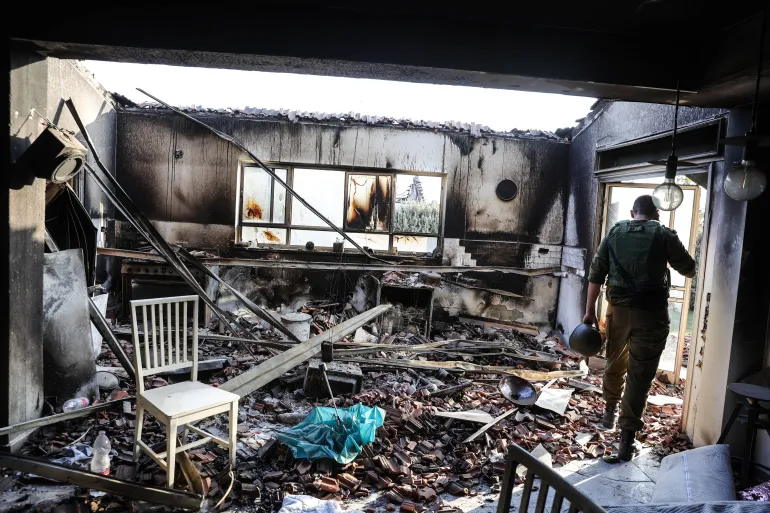
On October 7, 2023 — the Jewish holiday of Simchat Torah and the 50th anniversary of the Yom Kippur War — Hamas launched the largest terrorist attack in Israeli history, breaching the Gaza security fence at multiple points and deploying approximately 3,000 fighters into southern Israel's kibbutzim, towns, military bases, and the Nova music festival site. Over approximately twelve hours, Hamas and accompanying Palestinian Islamic Jihad fighters killed approximately 1,200 people — the majority Israeli civilians — in what constituted the single-deadliest day for Jewish people since the Holocaust. An estimated 250 people were taken hostage into Gaza, including infants, children, elderly people, and foreign nationals from dozens of countries.
The methods of killing documented by first responders, forensic investigators, the Israel Police, and international journalists were characterized by exceptional brutality. Kibbutz Be'eri, where 112 of its approximately 1,200 residents were killed, experienced house-to-house systematic murder, sexual violence against women, and the burning of houses with families inside. The Nova music festival massacre — in which 364 young Israelis attending an outdoor rave were killed and dozens taken hostage — was documented extensively through victims' own phone footage, body camera recordings from attackers, and subsequent witness testimony.
The October 7 attacks have been characterized by multiple human rights organizations and international legal scholars as constituting war crimes and crimes against humanity under international humanitarian law — specifically: the deliberate targeting of civilians, the taking of hostages, sexual violence used as a weapon, and extrajudicial killings. The UN Special Representative on Sexual Violence in Conflict published a mission report in March 2024 documenting "clear and convincing information" that sexual violence including rape, gang rape, and sexual mutilation occurred during the attacks. These findings have been contested by Hamas.
Antisemitism — the oldest form of racism in Western civilization — has experienced a documented resurgence globally in the twenty-first century, accelerating dramatically following the October 7, 2023 attacks and Israel's subsequent military response in Gaza. The resurgence is expressed across ideological lines: far-right antisemitism rooted in white nationalist and neo-Nazi movements; far-left antisemitism expressed through anti-Zionist discourse that frequently slides into classical antisemitic tropes about Jewish power and conspiracy; and Islamist antisemitism rooted in theological and political opposition to Israel that generalizes from Israeli state policy to hostility toward Jewish people globally. All three streams have produced documented violence and harassment against Jewish communities worldwide.
The conflation of criticism of Israeli government policy — which is legitimate political discourse — with hostility toward Jewish people as such is the defining challenge of contemporary antisemitism documentation. Jewish communities have consistently reported that post-October 7 harassment has targeted them not as individuals associated with Israeli government decisions but specifically as Jews — in synagogues, in schools, in online spaces, and in public demonstrations where antisemitic chants and imagery have appeared alongside ostensibly political protest. The International Holocaust Remembrance Alliance (IHRA) working definition of antisemitism, adopted by dozens of countries and institutions, attempts to draw this distinction while remaining contested in its application.
If you or your community have been affected by the events described in this report, we invite you to contribute to our documentation record.