Conflict Analysis & Human Rights
Region History
The record below traces the civilizations of the southeast, the road from the 1966 pogroms to secession and famine, and the contemporary jihadist pressure the desk documents as its continuation.
I · Foundations
Civilizations and Conquest
The peoples of the southeast built complex civilizations across millennia before the British arrived to name and administer them: the Nri Kingdom of sacred kingship, among the oldest in West Africa with traditions reaching to at least the tenth century CE; the Igbo-Ukwu bronzes of roughly the ninth century, whose discovery in 1938 overturned colonial assumptions about African civilization; the Aro Confederacy, anchored by the Arochukwu oracle, which dominated regional trade until the 1901 to 1902 Aro Expedition of over 3,500 British troops; and the Efik city-states of Calabar, whose Atlantic trade carried global significance. Lugard's 1914 amalgamation placed the Muslim, hierarchical north and the Christian, commercially dynamic south under one administration, and the Igbo produced Nigeria's first generation of lawyers, journalists, and nationalists inside a federal arithmetic that guaranteed permanent northern dominance.
II · 1966 & The War
Pogroms, Secession, and Famine
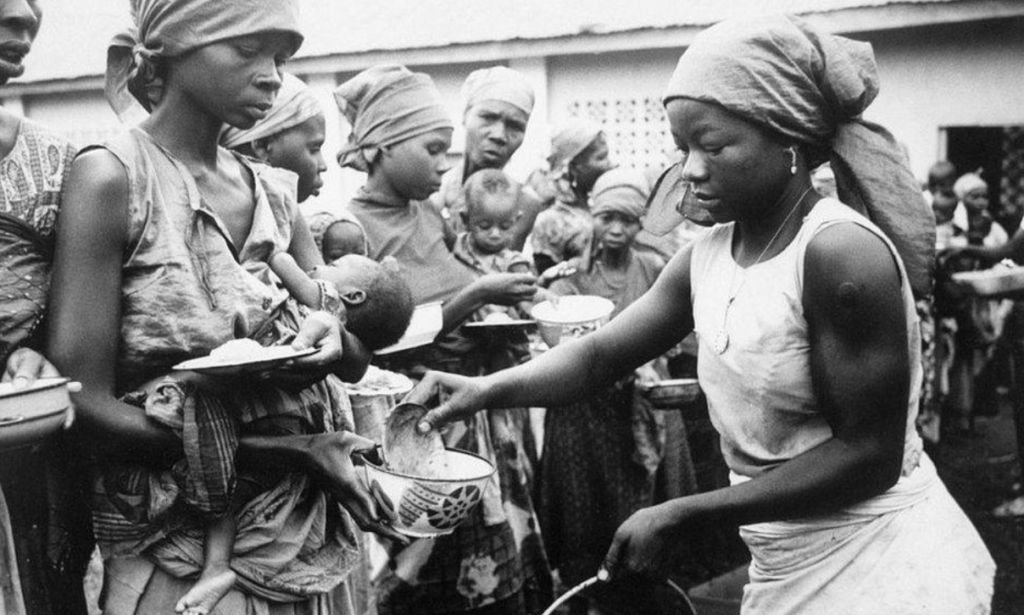
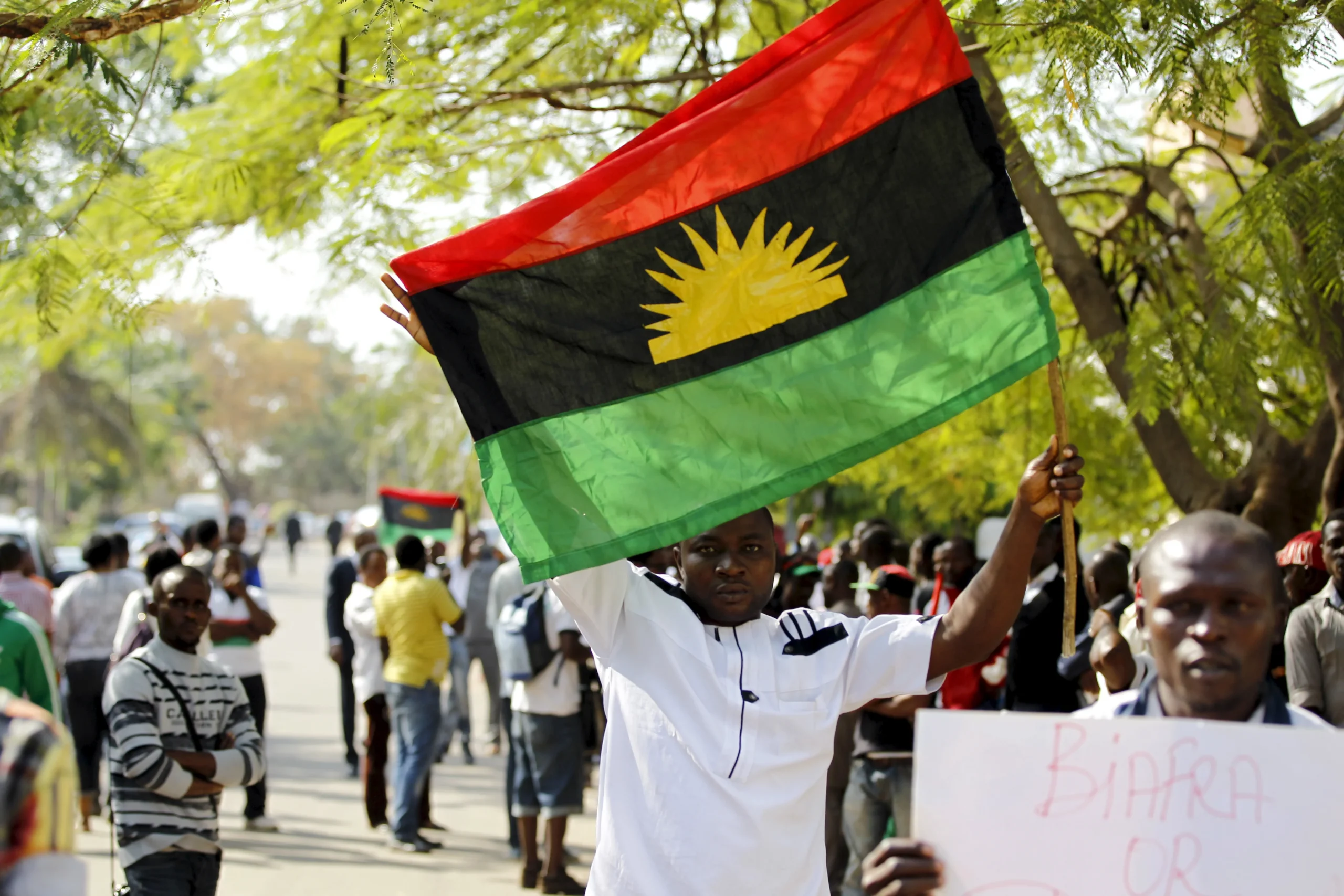
Nigeria's First Republic was consumed by ethnic and regional competition, and the January 1966 coup was read throughout the north as an Igbo power grab. The July counter-coup was followed by pogroms across northern Nigeria that killed an estimated 30,000 Igbo civilians and drove over one million people east in the largest internal displacement in Nigerian history, a mass killing that made separation feel to southeasterners like a survival imperative. The Republic of Biafra, declared on May 30, 1967, fought a 30-month war under total blockade; the deliberate famine that resulted killed between one and three million people, most of them children. Surrender came on January 15, 1970 under the formula of No victor, no vanquished, which in practice meant no trial, no truth commission, and no apology.
III · The Contemporary Threat
Jihadist Pressure on the Southeast
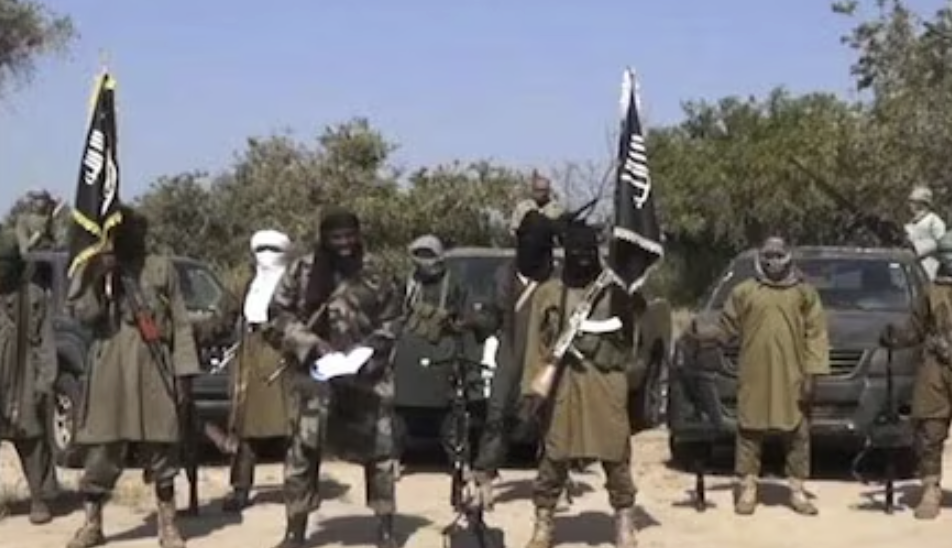
Since 2009, Boko Haram and ISWAP have killed over 35,000 people and displaced roughly two million in the northeast, while armed Fulani militia campaigns have spread from the Middle Belt into Anambra, Imo, and Ebonyi States. Not every herder-farmer clash is religious, and climate and grazing pressures are real; the documented pattern is distinct from that baseline: communities attacked at night or during worship, churches and food stores burned, priests and leaders killed, and cleared land occupied, in campaigns the International Crisis Group, USCIRF, and Open Doors identify as organized and ideologically framed. The federal government has prosecuted no perpetrators, designated IPOB a terrorist organization while declining to designate the armed groups whose attacks prompted the Eastern Security Network's formation in 2020, and repeated for southeasterners the abandonment of 1966.
"We were a people who had been singled out for destruction. The evidence was all around us: in the mass graves of the north, in the traumatized survivors who arrived with nothing, in the silence of the federal government. Biafra was not an ambition. It was a cry for life."
Chinua Achebe · There Was a Country, 2012
People of Biafra
The Communities of Biafra
Though the Igbo were its largest and most politically dominant people, the Republic of Biafra encompassed the full diversity of Nigeria's Eastern Region: the Efik and Ibibio of the coastal southeast, the Ijaw of the Delta, the Ogoni of the Rivers hinterland, the Ekoi and Boki of the Cross River basin, and dozens of smaller communities whose relationship to the Biafran project ranged from enthusiastic to ambivalent. The entries below document the principal communities, their traditions, and their experiences of the war, the famine, and the contemporary pressure.
Igbo
Also known as Ibo · Ndi Igbo
RegionAnambra · Imo · Enugu · Ebonyi · Abia States
Population~35 to 45 million (Nigeria) · millions in diaspora
LanguageIgbo (tonal, many dialects) · English
ReligionChristianity (predominantly) · Traditional
The central people of the Biafran story, organized through a republican tradition of village democracy, age-grade associations, women's councils, and title societies that distributed authority horizontally rather than concentrating it in hereditary rulers. Igbo traders and professionals had settled across Nigeria before 1966; the pogroms that drove over a million back east targeted a commercially successful minority whose success had bred resentment. Post-war reintegration was formally accomplished and practically punitive, and today Anambra and Imo communities face documented armed Fulani incursions, kidnapped priests, and burned churches that go unprosecuted.
Efik & Ibibio
Also known as Calabar peoples · Annang · Oron
RegionCross River State · Akwa Ibom State
Population~6 to 8 million (Ibibio) · ~1 million (Efik)
LanguageEfik · Ibibio · Annang · Oron
ReligionChristianity (predominantly) · Traditional
The eastern and coastal flank of Biafran territory, heirs to Calabar's centuries of Atlantic trade and to the Ekpe leopard society, which regulated commerce and transmitted sacred knowledge, and which survives in Cuba as the Abakuá, among the most remarkable African institutional transmissions across the Atlantic. Their relationship to Biafra was genuinely ambivalent, and the wartime creation of Rivers and Cross River States deliberately fractured non-Igbo constituencies; today Akwa Ibom and Cross River Christians navigate the same northern armed incursions and sense of federal abandonment as the wider southeast.
Ogoni
Also known as Khana · Gokana · Tai · Eleme
RegionOgoniland · Rivers State · Niger Delta
Population~1 million
LanguageKhana · Gokana · Tai · Eleme
ReligionChristianity · Traditional
A small people made globally visible by nonviolent resistance to oil-extraction devastation: the 1990 Ogoni Bill of Rights and Ken Saro-Wiwa's leadership of MOSOP articulated with extraordinary precision what it means to be a small people inside a large state indifferent to their existence, and his 1995 execution made him, in effect, a post-war casualty of the same structural violence that produced the famine. Ogoni communities now face converging environmental ruin and the southward movement of armed groups documented attacking churches in Rivers State.
Ijaw of the Eastern Delta
Also known as Izon · Nembe · Brass · Kalabari
RegionRivers State · Bayelsa · Eastern Niger Delta
Population~4 to 5 million (Eastern Ijaw communities)
LanguageIzon · Nembe · Kalabari · Brass
ReligionChristianity · Traditional water-spirit religion
The city-states of Bonny, Nembe, Brass, Kalabari, and Okrika dominated coastal Atlantic trade for centuries through sophisticated war-canoe house political systems. Historically distinct from the Igbo and split over secession, some communities backed Biafra while others took the federal offer of Rivers State; after the war they held oil beneath their land and poverty in their lives, the grievance that fueled the Delta insurgency of the 2000s. Christian Ijaw communities are now among the most exposed to the southward expansion of armed Fulani activity into the Delta.
Ekoi & Cross River Peoples
Also known as Ejagham · Boki · Mbembe · Yakö
RegionCross River State · Cameroon border highlands
Population~1 to 2 million (combined)
LanguageEjagham · Boki · Mbembe · Yako
ReligionChristianity · Traditional
Forest-highland peoples of the Nigeria and Cameroon border, creators of nsibidi, an indigenous ideographic script used across Ekoi, Efik, Ibibio, and Igbo communities for centuries before European contact and one of the few independently developed writing systems in sub-Saharan history, long dismissed by colonial scholars. At the margins of a war centered in Igboland, they suffered its occupation and food insecurity without authoring the secession; their Christian-majority communities now face documented armed incursions, with the forest border serving as a corridor for armed groups.
Women of Biafra
Also known as Ụmụ nwanyí Biafra · Market women
RoleCivil survival · Food networks · Reconstruction
Context1967 to 1970 war · Blockade survival
Precedent1929 Women's War · Aba market traditions
LegacyFlora Nwapa's literary documentation · Oral testimony
Largely invisible in official histories, women were the primary agents of civilian survival: drawing on market organization and long-distance trading traditions, they ran the informal food networks, smuggled food across military lines, and after the war led reconstruction as widows with nothing but organizational capacity and the children they had kept alive. Flora Nwapa preserved that experience in literature. Today women face documented sexual violence and abduction by armed groups attacking Christian farming communities, targeted as bearers of community identity and continuity.
The Biafran Diaspora
Also known as Igbo diaspora · Ndi Igbo n'elu ụwa
DestinationsUSA · UK · Canada · Ireland · South Africa
Population~3 to 5 million (Igbo diaspora worldwide)
FieldsMedicine · Law · Finance · Literature · Technology
OrganizationsOhanaeze Ndigbo · IPOB · Cultural associations
Forged by pre-war migration, the war itself, and successive waves of emigration, the diaspora has produced one of Africa's most accomplished global communities, its intellectual tradition running from Achebe through Chimamanda Ngozi Adichie. Communities in London, Houston, and Toronto whose parents or grandparents survived the famine monitor the contemporary security collapse with alarm, document anti-Christian and anti-Igbo violence for international audiences, and face pressure on their advocacy following Nigeria's designation of IPOB as a terrorist organization.
Biafran Intellectuals & Artists
Also known as the Biafran literary generation
FiguresChinua Achebe · Christopher Okigbo · Flora Nwapa
InstitutionUniversity of Nigeria Nsukka · Enugu arts community
WorksThings Fall Apart · There Was a Country · Labyrinths
LegacyAfrican literary canon · War testimony
The war produced, and was produced by, a remarkable concentration of talent centered on the University of Nigeria at Nsukka. Achebe served as Biafra's cultural ambassador and four decades later named the famine deliberate in There Was a Country; Christopher Okigbo, widely regarded as the greatest African poet of his generation, was killed in combat near Nsukka in August 1967; Flora Nwapa pioneered an African feminist literature of women's wartime survival. Their testimony has been read worldwide far more honestly than it has been engaged with inside Nigeria.
Appendix · The War Record and Contemporary Violations
Crimes Against the Biafran Peoples
This record documents the principal crimes committed against Biafran peoples: the 1966 pogroms, the mass atrocities and deliberate famine of 1967 to 1970, and the contemporary pattern of jihadist-affiliated violence targeting southeastern Christian communities. These events span more than half a century. None has been subject to a truth commission, a formal international inquiry, or any adequate process of transitional justice; they remain unresolved, and in the contemporary case, ongoing.
01
Ethnic Massacre · Forced Displacement
The 1966 Anti-Igbo Pogroms in Northern Nigeria
The precondition for secession was mass murder. Following the January 1966 coup and the July counter-coup, organized attacks on Igbo communities across northern Nigeria reached catastrophic scale in September and October: residents were identified and killed in their homes, workplaces, churches, and at railway stations as they tried to flee, with soldiers participating alongside civilians. Estimates range from 10,000 to 30,000 killed and over one million driven east, while the federal state prosecuted no one, demonstrating before the war even began its willingness to allow the massacre of Igbo people without consequence.
02
War Crimes · Civilian Massacres
Federal Military Atrocities Against Biafran Civilians
Federal advances into Biafran-held towns were repeatedly followed by documented killings, rape, and looting. At Asaba in October 1967, troops under Colonel Murtala Mohammed separated residents who had gathered to welcome them with white flags; men and boys were taken to an open space and shot, with estimates of the dead ranging from several hundred to over a thousand, a massacre the Nigerian state has never acknowledged. Systematic sexual violence and the looting and destruction of food stores, churches, and schools were documented by ICRC workers and foreign journalists throughout the war.
03
Jihadist Terrorism · Anti-Christian Violence
Boko Haram, ISWAP and the Expansion of Jihadist Violence
Boko Haram's Salafi-jihadist insurgency has killed over 35,000 people and displaced roughly two million in the northeast since 2009, framing Christians, the Western-educated, and the secular state as enemies of Islamic governance. The 2014 abduction of 276 predominantly Christian schoolgirls from Chibok, taken with explicit statements about conversion and slavery, concentrated global attention on that ideology; over 100 remain missing a decade later. Dozens of church bombings timed to Christmas and Easter, including the Madalla attack that killed 44 worshippers on Christmas Day 2011, mark a documented anti-Christian campaign whose character the government has been reluctant to formally acknowledge.
04
Organized Violence · Anti-Christian Persecution
Armed Fulani Militia Attacks on Christian Communities
Armed Fulani militia campaigns across the Middle Belt, and increasingly in Anambra, Imo, and Ebonyi States, follow a documented template: communities attacked at night or during worship, churches and food stores burned alongside homes and farms, priests and community leaders killed, and cleared land subsequently occupied, a progression consistent with territorial expansion rather than grazing disputes. The June 2018 Barkin Ladi attacks in Plateau State killed over 200 people; the Anambra Catholic Diocese reported priests kidnapped and murdered between 2020 and 2023. No perpetrators have been prosecuted, while IPOB carries a terrorist designation and the armed groups that prompted its security wing do not.
05
Genocide · Deliberate Famine · Crimes Against Humanity
The Biafran Famine: Starvation as a Weapon of War
The defining crime of the war: a naval and land blockade that cut sea-borne food to a territory of eight to twelve million people, maintained as declared policy, with Federal Commissioner for Finance Obafemi Awolowo stating publicly that starvation was a "legitimate weapon of war." The Uli night airlift delivered around 300 tons of food at its peak against a need of roughly 1,500 tons per day, and the airstrip was repeatedly bombed. Conservative estimates place civilian deaths at one million, ranging as high as three million, the majority children under five killed by kwashiorkor, marasmus, and famine disease; scholars including Herbert Ekwe-Ekwe and Achebe have characterized the famine as genocide. Surrender on January 15, 1970 brought the No victor, no vanquished formula: no trial, no truth commission, no apology.
1 to 3M
Estimated Biafran civilian deaths, the majority from deliberate famine
~1M
Children who died of kwashiorkor malnutrition during the blockade
30
Months of federal naval and land blockade of Biafra
0
Perpetrators prosecuted · truth commissions held · apologies issued
06
International Complicity · Diplomatic Abandonment
The International Community's Role in the Catastrophe
Britain supplied the federal government with arms and diplomatic cover throughout the war while calling the conflict internal, with cables released decades later showing officials knew the famine's deliberate character and devastating scale; the Soviet Union provided the aircraft that bombed civilian areas and the Uli relief airstrip, and the United States declined to use its leverage to compel humanitarian access. Only Tanzania, Zambia, Ivory Coast, Haiti, and Gabon recognized Biafra. The most consequential response came too late: French doctors returning from Biafra founded Médecins Sans Frontières in 1971 on the duty of humanitarian workers to speak publicly about witnessed atrocity, a standing monument to what international silence had permitted.
5
Countries that formally recognized the Republic of Biafra
£12M+
Estimated British arms supplied to federal Nigeria during the war
MSF
Founded by French doctors from Biafra who refused future silence
0
UN Security Council resolutions on the famine or atrocities