Dossier Leader
Rania Dean
Founder, Covenant · Board Member, ICAN
Rania Dean is an Israeli-American Druze based in Los Angeles, a public diplomacy advocate, political analyst, and civic leader focused on Middle Eastern affairs and minority rights. She is the founder of Covenant, an advocacy and humanitarian organization dedicated to defending the rights, security, and existence of ethno-religious minorities across the Middle East, and serves on the board of the Israeli-American Civic Action Network (ICAN). Born and raised in northern Israel, she grew up under the constant threat of terrorism and regional conflict, experiences that shaped her commitment to advocacy and cross-community alliances. Fluent in Arabic, Hebrew, and English, with an academic background spanning biotechnology engineering, political science, and international relations, she participated in the Tikva Program for Political Leadership at Reichman University, served as a young advisor to former Israeli President Shimon Peres, and is a frequent speaker and media guest on Middle Eastern affairs, minority rights, and public diplomacy.
Conflict Analysis & Human Rights
Region History
The record below traces the faith's origins and the mountain strategy of survival, the jihadist campaigns that have targeted the community as apostates, and the acute uncertainty of the post-Assad Levant.
I · Foundations
Origins, al-Hikma, and the Mountain Refuge
The Druze faith emerged in Cairo between roughly 1017 and 1023 CE, in the reign of the Fatimid Caliph al-Hakim bi-Amr Allah, through founders including the Persian mystic Hamza ibn Ali, synthesizing Ismaili Shia Islam with Neoplatonic philosophy and older intellectual traditions. Persecuted after al-Hakim's disappearance in 1021, its followers dispersed to the mountains: the Jabal al-Druze of southern Syria, Mount Lebanon, and the Galilee highlands. The theological core, al-Hikma, remains closed to outsiders and to most Druze themselves, divided between the initiated uqqal and the uninitiated juhhal; conversion in is impossible and conversion out a grave violation. Across a millennium the community survived through strategic accommodation with whichever power held its territory, martial reputation, and fierce solidarity. That history includes a chapter requiring honest acknowledgment: in 1860, Druze forces killed an estimated 11,000 Maronite Christians in Mount Lebanon, a record of perpetration that coexists with the community's own long experience of massacre.
II · Jihadist Threat
Declared Apostates: Idlib and Sweida
Salafi-jihadist ideology classifies the Druze as apostates, murtaddun, outside even the subordinated protections of dhimmi status, a designation that functioned as a predicate for organized killing once the Syrian war gave jihadist groups unprecedented capacity. In June 2015, Jabhat al-Nusra fighters entered the Idlib village of Qalb Lawzeh and killed at least 20 civilians after demanding they renounce their faith; under jihadist governance the ancient Druze community of the Jabal al-Summaq, roughly 100,000 people before the war, was effectively eliminated as a functioning community through forced conversion, shrine destruction, and flight. On July 25, 2018, ISIS launched coordinated dawn assaults on villages across Sweida Governorate, killing over 250 civilians and abducting around 36 women and children who were held for months, the worst single atrocity against the Druze in the modern era.
III · The Present
Between Hezbollah, HTS, and an Uncertain Syria
Lebanese Druze navigated civil war, Syrian occupation, and Hezbollah's military dominance with characteristic pragmatism under the Jumblatt family's leadership, a history that includes the 1983 expulsion of Christian communities from the Chouf and the reconciliation process that later acknowledged it, among postwar Lebanon's few genuine achievements of its kind. In Syria, Sweida's exhaustion produced the August 2023 protests, months of disciplined demonstrations rejecting both the Assad government and the jihadists who had attacked the community. The fall of Damascus in December 2024 to HTS-led forces confronted every Druze community with acute uncertainty: Sweida's leadership has engaged the new authorities while keeping independent community defense forces as a hedge, Golan Druze face the collapse of the Syrian sovereignty they maintained loyalty to for five decades, and HTS assurances coexist with its predecessor's documented record in Idlib.
"We are a people who have survived by knowing which mountain to stand on, which alliance to honor, and when to fight and when to wait. We have made mistakes. We have been massacred. We have survived. That is the whole of our history."
Druze Community Elder · Minority Rights Group, Lebanon, 2018
A Regional Encyclopedia
The Levantine Druze Community
The Druze are a transnational people whose four principal concentrations, in Syria, Lebanon, Israel, and Jordan, have developed distinct political identities shaped by the states in which they live, while maintaining a deep consciousness of shared religious tradition, genealogical connection, and communal solidarity across borders. The entries below document these communities, their social institutions, and their specific experiences of persecution and survival across the modern period.
Syrian Druze
Also known as Druze of Jabal al-Arab · Sweida Druze
RegionSweida Governorate · Jabal al-Arab · Southern Syria
Population~700,000 to 800,000 (pre-war) · reduced by displacement
LanguageLevantine Arabic · Druze Arabic dialect
FaithDruze (al-Hikma tradition)
The largest Druze population in the world, anchored on the volcanic basalt plateau whose terrain has historically protected the community, and heirs to the Great Syrian Revolt of 1925 to 1927 initiated by Sultan al-Atrash. Their accommodation with the Assad government was pragmatic rather than enthusiastic, and it eroded as the war ground on: conscription increasingly refused, local defense forces organized, aspirations for autonomy articulated. They face jihadist groups that declare them apostates, the legacy of the July 2018 ISIS massacre, and the profound insecurity of the post-Assad transition.
Lebanese Druze
Also known as Druze of the Chouf · Mountain Druze
RegionChouf · Aley · Hasbaya · Mount Lebanon
Population~250,000 to 350,000 (Lebanon)
LanguageLebanese Arabic · Druze Arabic dialect
FaithDruze (al-Hikma tradition)
Holders of a constitutionally allocated place in Lebanon's confessional power-sharing system, led for generations by the Jumblatt family's Progressive Socialist Party: Kamal Jumblatt, assassinated in 1977, remains a defining figure, and Walid Jumblatt led the community across nearly five decades of repositioning within Lebanon's landscape. Their Civil War record includes both victimization and the 1983 Mountain War expulsion of Christian communities from the Chouf, later addressed through a genuine reconciliation process; today they navigate a collapsing state under Hezbollah's military dominance, with new uncertainty spilling over from southern Syria.
Israeli Druze
Also known as Druze of the Carmel · Galilee Druze
RegionCarmel · Galilee · Golan Heights
Population~145,000 to 160,000 (Israel)
LanguageArabic · Hebrew (fluent) · Druze Arabic dialect
FaithDruze (al-Hikma tradition)
The most thoroughly state-integrated Druze community, formalized in 1956 when Druze leaders requested inclusion in Israel's military conscription: the blood covenant under which Druze soldiers have served, and fallen, in every Israeli war since 1948, including in elite units and senior ranks. The 2018 Nation-State Law provoked significant Druze protest from reserve officers and community leaders who read it as compromising the equality their loyalty had earned, and the community carries the anguish of watching kin in Sweida face ISIS while political constraints limit intervention on their behalf.
Golan Heights Druze
Also known as Jawlan Druze · Syrian Druze of the Golan
RegionGolan Heights (Jawlan) · Majdal Shams · Masada · Buq'ata
Population~22,000 to 25,000
LanguageArabic · Hebrew · Druze Arabic dialect
FaithDruze (al-Hikma) · Syrian national identity maintained
Residents of territory captured by Israel in 1967 and formally annexed in 1981, whose majority has consistently refused Israeli citizenship across generations born entirely under Israeli administration, an expression of the Druze principle of loyalty to one's sovereign. The Shouting Hill at Majdal Shams, where divided families called to relatives across the ceasefire line, became one of the era's most poignant symbols. The collapse of the Assad government in December 2024 dissolved the sovereign reference point around which fifty years of political calculation had been built, forcing reassessment amid fear for kin in Sweida.
Jordanian Druze
Also known as Druze of Azraq · Hauran Druze in Jordan
RegionAzraq · Zarqa · Amman metropolitan area
Population~30,000 to 50,000 (Jordan)
LanguageJordanian Arabic · Druze Arabic dialect
FaithDruze (al-Hikma tradition)
The smallest of the four principal national communities, descended largely from Druze who settled the Hauran in the late Ottoman period and found themselves inside Jordanian territory after the post-World War I partition of the Levant. They have integrated effectively into Jordanian society and its military, protected by comparatively capable security services, and their relative marginality has meant less international documentation than their kin receive. Their principal contemporary concern is the fate of Syrian Druze relatives in Sweida, with whom close family connections cross the border.
Druze Women
Also known as Muwahhidat · Uqqal women
Religious RoleUqqal (initiated) · Community moral anchor · Oral tradition
Social RoleCommunity cohesion · Hospitality networks · Cultural transmission
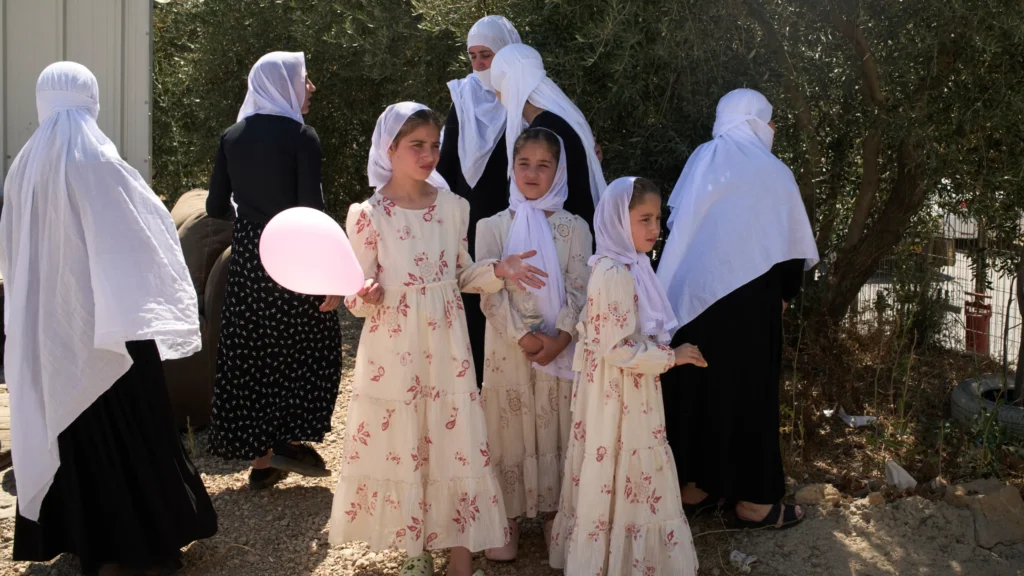
DressWhite headcovering (mandil abyad) for initiated women
StatusTheologically equal · Socially constrained · Targeted in attacks
Al-Hikma provides for women's initiation into the uqqal on equal terms with men, and many of the community's most respected religious figures across history have been women, recognizable by the white mandil abyad; the gap between that theological equality and a constrained social reality has been a persistent tension in Druze life. Jihadist groups have targeted Druze women deliberately as instruments of communal destruction: the 36 women and children abducted in the 2018 Sweida massacre endured months of captivity, and Jabhat al-Nusra's Idlib operations imposed forced marriage and dismantled the initiated women's religious role.
Druze Religious Leadership
Also known as Uqqal · Ajawid · Shuyukh al-'Aql
TitlesSheikh al-'Aql · Ajwad · Sheikh
FunctionCustodians of al-Hikma · Community mediation · Political counsel
Sacred TextsRasa'il al-Hikma (Letters of Wisdom), restricted
InstitutionNo formal clergy hierarchy · Authority through recognition
A non-hereditary, non-professional initiated class recognized for spiritual attainment and ethical conduct rather than institutional training; there is no Druze equivalent of the imam, the priest, or the rabbi. The structure is resilient, with no institution to close and no clergy payroll to cut, and simultaneously vulnerable, because the tradition lives in people. Jihadist groups have targeted sheikhs and initiated women precisely as embodiments of the tradition, destroying majlis al-uqqal and desecrating shrines in a deliberate attack on the mechanisms by which al-Hikma is transmitted and sustained.
The Druze Diaspora
Also known as Druze of the Americas · Mahjar Druze
DestinationsUSA · Brazil · Canada · Australia · Venezuela
Population~100,000 to 200,000 (diaspora)
OrganizationsAmerican Druze Society · World Druze Council
IdentityPrimarily social identity rather than religious practice
Built through late Ottoman emigration from Mount Lebanon and the later waves driven by the Lebanese Civil War and the Syrian crisis, the diaspora maintains Druze identity chiefly as social solidarity and family network: without a critical mass of initiated uqqal, and with a faith no one may convert into, it grows only by birth. The 2018 Sweida massacre galvanized diaspora organizations in the United States, Canada, and Australia to lobby Western governments for the protection of Syrian Druze, supplementing coverage that mainstream international media provides only intermittently.
Appendix · A Historical Record
Crimes Against the Levantine Druze
This record documents the principal crimes committed against Levantine Druze communities across the modern period, from Ottoman-era violence through the jihadist campaigns of the Syrian civil war and its aftermath, drawing on documentation by Human Rights Watch, Amnesty International, the Syrian Observatory for Human Rights, the UN Commission of Inquiry on Syria, the Minority Rights Group, and survivor testimony. It also records what the community's own history requires: episodes in which Druze forces perpetrated communal violence. Many of these events have never been subject to accountability, formal investigation, or international legal process.
01
Communal Massacre · State Violence
Ottoman Period Massacres and Sectarian Violence
Ottoman governors mounted periodic campaigns against Druze autonomy, taxation resistance, and conscription refusal: in 1838, forces under Ibrahim Pasha killed hundreds of Druze and destroyed villages across the Hauran. The century's most consequential episode is one this record states plainly: in 1860, Druze forces were primarily perpetrators, killing an estimated 11,000 Maronite Christians in Mount Lebanon and displacing over 100,000, violence that brought French military intervention and the Mutasarrifate of Mount Lebanon. In 1925 to 1927, French Mandate forces suppressed the Great Syrian Revolt initiated by Sultan al-Atrash with aerial bombardment of Druze villages and of Damascus itself, killing an estimated 6,000 Syrians with no accountability for the authorities responsible.
02
Jihadist Massacre · Forced Conversion
Jabhat al-Nusra Attacks on Druze Communities in Idlib
When Jabhat al-Nusra consolidated control of Idlib in 2015, the ancient Druze communities of the Jabal al-Summaq faced demands for conversion, destruction of shrines, prohibition of religious practice, forced marriage, and property confiscation. In June 2015, fighters entered the village of Qalb Lawzeh and killed at least 20 civilians after demanding they renounce their faith, killings Human Rights Watch documented through survivor testimony and satellite imagery against the group's claim of a mere dispute. Between 2015 and 2019, Nusra and then HTS destroyed Druze maqamat and majlis al-uqqal so systematically that no shrine in their territory is reliably documented as surviving intact.
03
Terrorist Massacre · Kidnapping · Crime Against Humanity
The ISIS Sweida Massacre of July 25, 2018
At dawn on July 25, 2018, ISIS fighters simultaneously attacked the villages of Shbaa, al-Rasas, al-Shabki, and Shrehi, conducting house-to-house executions that killed over 250 civilians while planted bombs struck Sweida city's market, coordination that demonstrated planning rather than opportunism. Fighters abducted approximately 36 Druze women and children into the desert, where they were held for seven to nine months under forced religious observance and threats of sexual slavery; most were released through tribal mediation and ransom, and several died in captivity. The UN Commission of Inquiry documented murder, abduction, and persecution on religious grounds, while nearby government forces failed to intervene in the critical first hours.
04
Religious Persecution · Cultural Destruction
Forced Conversion and the Destruction of Druze Identity
For a closed community that no one may join, forced conversion is communal destruction: a forcibly converted village ceases, in communal terms, to exist as a Druze village, and children raised under jihadist governance lose access to the tradition, the networks, and the initiated community through which al-Hikma is transmitted. ISIS extracted the shahada from Druze in eastern Syria between 2014 and 2019 under threat of death; under HTS governance in Idlib, remaining Druze have been required to observe Sunni dress codes and prayer schedules, men prohibited from the distinctive Druze mustache and women required to adopt the hijab, the systematic erasure of Druze markers from public life.
05
Political Repression · Civilian Insecurity
The 2023 Sweida Uprising and the Crisis of Governance
In August 2023, tens of thousands of Druze filled the streets of Sweida for months of disciplined protest demanding the fall of the Assad government, implementation of UN Security Council Resolution 2254, and the release of political prisoners, the most significant sustained anti-Assad demonstration by any community in years, explicitly rejecting both the government and the jihadists who had attacked them. The fall of Damascus in December 2024 replaced that government with HTS-led authorities whose predecessor's record in Idlib the community has no institutional reason to trust; Sweida's leadership has engaged cautiously while keeping independent defense forces, as ISIS maintains an active presence in the desert to the east.
250+
Druze civilians killed in the July 2018 ISIS Sweida massacre
~100K
Druze displaced from Idlib Governorate by the Syrian war
Dec 2024
Fall of the Assad government, acute uncertainty for Syrian Druze
0
ISIS perpetrators prosecuted for the Sweida massacre
06
International Neglect · Accountability Failure
The International Community's Failure to Protect the Druze
The Yazidis, declared apostates by the same ideology and subjected to killing, abduction, and enslavement, received sustained global attention and formal genocide recognition; the Druze, who suffered comparable violence in the same context, received minimal sustained engagement, a disproportion reflecting their smaller size, their distribution across states with competing interests, the political complexity of their relationship to Israel, and the absence of a powerful advocacy network. No perpetrator of the 2018 Sweida massacre has been prosecuted anywhere: Syria never ratified the Rome Statute, and Russian and Chinese vetoes have blocked Security Council referral to the ICC since France's 2014 attempt. Shrine destruction documented by UNESCO has likewise proceeded without a single charge or sanction.