

Biafrans: Region History
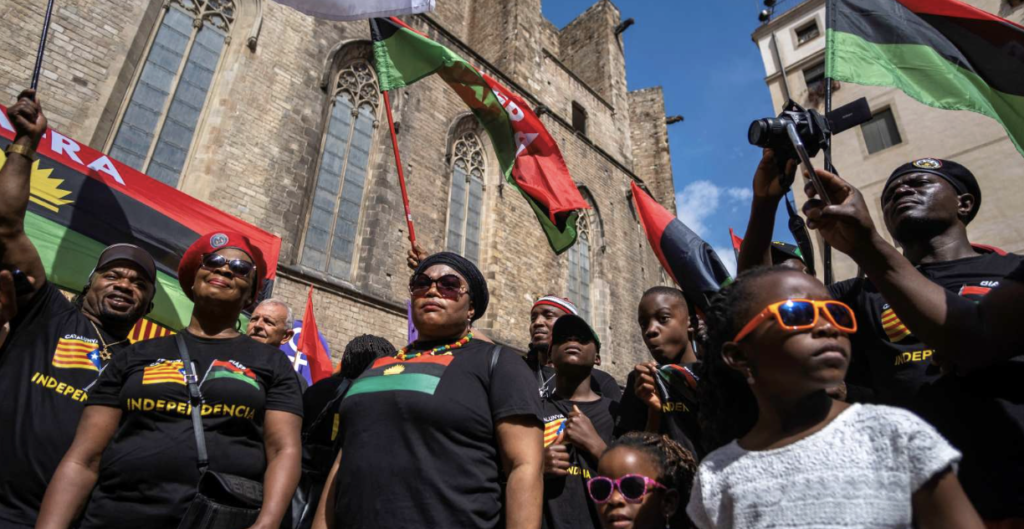
"Biafran" is simultaneously a historical identity — the nationality of citizens of the short-lived Republic of Biafra, which existed from May 30, 1967 to January 15, 1970 — and a living political identity claimed by millions of people in southeastern Nigeria who assert a distinct peoplehood rooted in pre-colonial civilization, a shared experience of mass atrocity, and an unresolved grievance with the Nigerian federal state that five decades of official silence have not extinguished. The peoples who constituted Biafra — predominantly Igbo, but also Efik, Ibibio, Ijaw, Ogoni, Ekoi, and others of the Cross River and Rivers hinterlands — inhabited one of the most densely populated and culturally vibrant territories in West Africa. Their attempted secession in 1967, and the war that followed, produced one of the twentieth century's most devastating humanitarian catastrophes: a deliberate famine that killed between one and three million people, the majority of them children. Today, Biafran-majority communities face a new and distinct threat — the sustained ideological and physical pressure of jihadist violence emanating from northern Nigeria, whose consequences for Igbo and southeastern Christian communities constitute a continuation, by different means, of the logic of elimination that produced the 1966 pogroms and the Biafran famine.
Part I — Historical Foundations
Ancient Civilizations, Colonial Disruption, and the Road to Secession
The peoples of the southeast had developed complex, organized civilizations across millennia before the British arrived to name and administer them. The Nri Kingdom — centered at Nri in what is today Anambra State — is among the oldest known kingdoms in West Africa, with traditions of sacred kingship, bronze casting, and spiritual authority stretching back to at least the tenth century CE. Nri wielded authority through ritual prestige rather than armed force: its priests were called upon across Igboland to perform purification rites and consecrate the ground for community life, reflecting the deeply egalitarian and morally grounded character of Igbo political philosophy. The Igbo-Ukwu bronzes — extraordinary metalwork dating to approximately the ninth century CE, discovered in 1938 — permanently overturned colonial-era assumptions about African civilization and testified to the antiquity and technical sophistication of southeastern Nigerian culture.
The most significant pre-colonial political-commercial formation in Igboland was the Aro Confederacy — a network of trading communities anchored by the Arochukwu oracle in what is today Abia State — which dominated long-distance trade across southeastern Nigeria from approximately the seventeenth century through British conquest in 1902. Beyond Igboland, the Efik city-states of Calabar on the Cross River estuary conducted Atlantic trade of global significance, while the Ibibio, Ogoni, Ijaw, and Ekoi peoples of the hinterland each maintained distinct civilizations with their own languages, governance structures, and artistic traditions.
British Conquest and the Eastern Region
British conquest of southeastern Nigeria proceeded through a combination of fraudulent treaties, naval bombardment, and organized military expeditions. The Aro Expedition of 1901–1902 — mounted to destroy the Arochukwu oracle and break Aro commercial dominance — involved over 3,500 troops and resulted in the formal incorporation of Igboland into the British protectorate. Frederick Lugard's 1914 amalgamation of Northern and Southern Nigeria placed the deeply Muslim, hierarchically organized north and the Christian, educated, commercially dynamic south under a single administration — creating a structural imbalance whose consequences would unfold across the following century. The Igbo, who had developed the highest rates of Western education in the country through missionary school networks, produced Nigeria's first generation of lawyers, journalists, and nationalist politicians — but within a federal arithmetic that guaranteed the numerically larger north would dominate federal power indefinitely.
The First Republic's Failure and the 1966 Massacres
Nigeria's First Republic (1960–1966) was consumed by ethnic and regional competition. Igbo professionals and traders had dispersed across Nigeria as teachers, civil servants, and merchants — their presence in the north particularly concentrated. The January 1966 military coup was interpreted throughout the north as an Igbo power grab regardless of its actual motivations. The counter-coup of July 1966, followed by a sustained wave of anti-Igbo pogroms across northern Nigeria, killed an estimated 30,000 Igbo civilians and drove over one million people southward to the Eastern Region in the largest internal displacement in Nigerian history. It was this mass killing that made the logic of separation feel to southeastern Nigerians not like a choice but like a survival imperative.
We were a people who had been singled out for destruction. The evidence was all around us — in the mass graves of the north, in the traumatized survivors who arrived with nothing, in the silence of the federal government. Biafra was not an ambition. It was a cry for life.
— Chinua Achebe, There Was a Country, 2012Part II — Jihadism and Ideological Pressure
Jihadism and Islamist Pressure as Drivers of Insecurity in Biafran-Majority Regions
The contemporary insecurity facing Biafran-majority communities in southeastern and south-central Nigeria cannot be understood in isolation from the broader pattern of Islamist ideological expansion and jihadist violence that has reshaped Nigeria's security landscape since the early 2000s. Two distinct but overlapping dynamics — the Boko Haram and Islamic State West Africa Province (ISWAP) insurgency in the northeast, and the sustained campaign of violence by armed Fulani herdsmen operating across the Middle Belt and increasingly into southeastern states — have together created a pattern of anti-Christian, anti-Igbo, and anti-southern violence with documented ideological dimensions that the Nigerian federal government has been systematically unwilling to acknowledge, investigate, or restrain.
It is essential to be precise about the ideological character of this violence. Not all Fulani herdsmen are jihadists; not all cattle-farmer conflict is religiously motivated; and the structural drivers of herder-farmer violence — climate change, desertification, population growth, and the collapse of traditional grazing route agreements — are real and important. However, a significant and growing body of documentation from the International Crisis Group, the United States Commission on International Religious Freedom (USCIRF), Christian Solidarity International, the Jubilee Campaign, and Nigerian civil society organizations demonstrates that elements of the violence targeting Christian and predominantly Igbo communities in the Middle Belt and southeast carry explicit religious framing, are organized rather than spontaneous, and are conducted by actors who articulate their campaign in the language of Islamist ideological expansion — the establishment of Islamic dominance over territories they identify as strategic.
Boko Haram, ISWAP, and the Northeastern Insurgency's Southern Reach
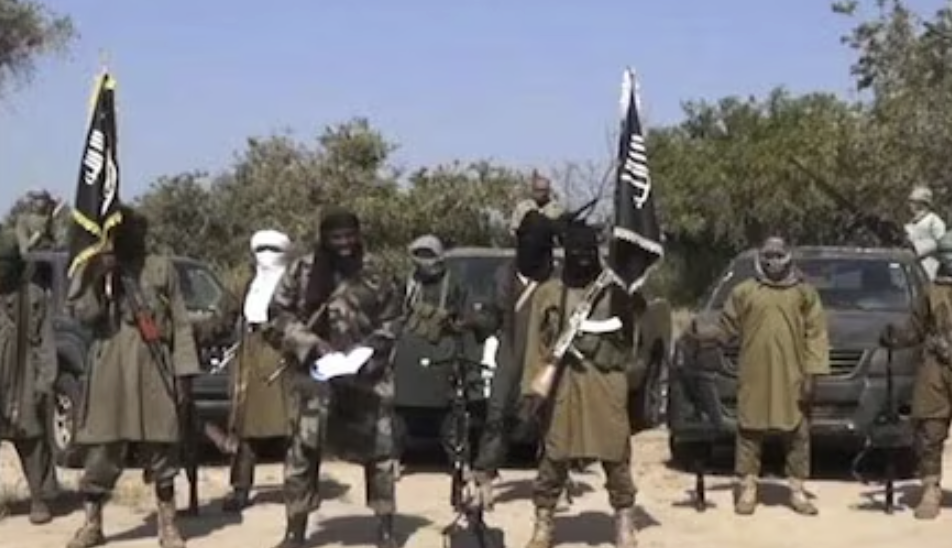
Boko Haram — whose name is commonly translated as "Western education is forbidden" — emerged in Maiduguri in the early 2000s as a Salafi-jihadist movement rejecting the Nigerian state and its secular constitutional framework as incompatible with Islamic governance. Its subsequent evolution through phases of insurgency, mass atrocity, and formal affiliation with the Islamic State produced a conflict that has killed over 35,000 people and displaced approximately two million in Nigeria's northeast since 2009. While the northeast — Borno, Yobe, Adamawa States — is geographically distant from the Igbo southeast, the insurgency's consequences have reached southward through two mechanisms: the destabilization of Nigerian security institutions whose attention and resources are consumed by the northeast, and the documented southward movement of armed Fulani militia groups whose ideological networks intersect with Boko Haram-adjacent Islamist frameworks.
The abduction of 276 schoolgirls from Chibok in 2014 — predominantly Christian girls whose school Boko Haram had specifically targeted as a symbol of Western education, and who were taken with explicit statements about conversion, slavery, and sexual violence framed in jihadist theological terms — demonstrated the extent to which anti-Christian, anti-education ideology was structuring organized mass violence. The ideological logic that targeted Chibok's Christian schoolgirls is the same logic, operating at a different geographic and organizational scale, that targets Christian farming communities in the Middle Belt and increasingly in southeastern Nigeria.
Armed Fulani Militias and the Pattern of Anti-Christian Violence
The violence perpetrated by armed Fulani militia groups across Nigeria's Middle Belt — in Plateau, Benue, Kaduna, Taraba, Kogi, and increasingly Anambra and Imo States — has been documented extensively by Nigerian and international human rights organizations. The International Crisis Group's 2017 and 2020 reports on farmer-herder conflict in Nigeria documented a shift from localized, dispute-driven violence to organized militia campaigns targeting specific communities, burning churches as well as farms, killing community leaders and priests alongside farmers, and operating in patterns consistent with the pursuit of territorial control rather than the resolution of grazing disputes. Open Doors World Watch List — which monitors Christian persecution globally — has consistently ranked Nigeria among the top ten countries for Christian persecution, citing both Boko Haram and Fulani militia violence as primary drivers.
The pattern documented in Plateau State's Berom communities, in Benue State's Tiv farming villages, and increasingly in Anambra and Imo States in the southeast follows a recognizable template: communities are attacked at night or during religious gatherings; churches, community buildings, and food stores are burned; community leaders and priests are killed alongside other civilians; and the attacks are followed not by a return to pre-attack patterns but by occupation of the cleared land. This progression — from raid to displacement to occupation — is consistent with the territorial expansion logic documented in jihadist strategy documents and is distinct from the pattern of herder-farmer conflict driven purely by grazing access disputes, in which violence typically subsides once immediate resource competition is resolved.
Federal Government Impunity and the Political Dimensions of Non-Response
The Nigerian federal government's response to armed Fulani militia violence — characterized by persistent failure to prosecute perpetrators, refusal to designate armed Fulani groups as terrorist organizations, and in documented cases, the deployment of military force against communities defending themselves while leaving the attackers unmolested — has been identified by critics, including the United States State Department and the European Parliament, as a dimension of the crisis rather than a solution to it. The ethnic and religious identity of senior federal security officials — many of whom are Muslim and northern — has been cited by Nigerian civil society organizations as a factor in the selective application of counterterrorism frameworks that designate Boko Haram as a terrorist organization while declining to apply equivalent designations to armed Fulani groups responsible for comparable civilian casualties.
For Biafran-majority communities in the southeast and south-central Nigeria, this pattern of federal non-response carries particular historical resonance: it replicates the dynamic of the 1966 pogroms, in which the Nigerian federal state stood aside while northern military and civilian actors killed Igbo civilians without accountability or consequence. The IPOB movement's security arm — the Eastern Security Network (ESN), formed in 2020 — emerged explicitly in response to what southeastern communities described as the Nigerian federal government's failure to protect Igbo and southeastern Christians from armed Fulani attacks. Its formation, and the federal government's designation of IPOB as a terrorist organization while continuing not to designate the armed Fulani groups that triggered its formation, reflects the political asymmetry that has characterized federal-southeastern relations since 1966.
The Fulani attacks on Igbo communities are not farmer-herder disputes. They are organized, they are ideological, and they are protected by the silence of a federal government that has never found a southeastern life worth defending. We have seen this before. We know how this ends if nothing changes.
— Southeastern Nigerian community leader, testimony collected by Christian Solidarity International, 2021The Targeting of Christian Identity and the Destruction of Religious Sites
Among the most consistent and documented patterns in the armed violence targeting Biafran-majority communities is the deliberate targeting of Christian religious infrastructure — churches, Christian schools, and the persons of priests, pastors, and catechists — in a pattern that multiple human rights investigators have characterized as the deliberate destruction of Christian communal life as a dimension of territorial expansion. The Anambra Catholic Diocese reported the abduction and murder of multiple Catholic priests by unknown armed groups between 2020 and 2023. The burning of churches in Imo and Anambra States has been documented by Aid to the Church in Need and other Catholic humanitarian organizations. The killing of Sunday school teachers and worship leaders in Plateau State communities has been reported with sufficient consistency across independent sources to constitute a documented pattern rather than random violence.
The targeting of Christian religious sites and personnel by Islamist-affiliated armed groups is not unique to Nigeria — it is a documented pattern across the Sahel, in Mali, Burkina Faso, Niger, and the Central African Republic, where jihadist expansion has consistently identified Christian community institutions as symbols of the cultural and political order that Islamist ideology seeks to replace. In the Nigerian context, the specific targeting of Igbo Christian communities and their religious infrastructure links the contemporary jihadist pressure to the historical logic of the 1966 pogroms — in which Igbo Christians were identified as a community to be eliminated from northern territory — and provides the context within which the IPOB movement's rhetoric of existential threat resonates with its constituency even among southeastern Nigerians who do not endorse its methods.
Part III — Biafran Communities
Biafran Peoples: An Ethnic & Cultural Encyclopedia
The Republic of Biafra was not an Igbo state — though the Igbo were its largest and most politically dominant people. It encompassed the full diversity of Nigeria's Eastern Region: the Efik and Ibibio of the coastal southeast, the Ijaw of the Delta, the Ogoni of the Rivers hinterland, the Ekoi and Boki of the Cross River basin, and dozens of smaller ethnic communities whose relationship to the Biafran project was complex, sometimes enthusiastic, sometimes ambivalent. The entries below document the principal communities that constituted Biafran society — their origins, cultural traditions, and their specific experiences of the war's mass atrocities, the deliberate famine, and the contemporary jihadist pressure that continues to threaten their survival and cultural integrity.
The Igbo are the central people of the Biafran story — the ethnic group whose political leadership drove the secession, whose territory constituted Biafra's heartland, and whose civilian population bore the famine's most catastrophic mortality. They are organized through one of West Africa's most distinctive political traditions: a republican system of village democracy, age-grade associations, women's councils, and title societies that distributed authority horizontally rather than concentrating it in hereditary rulers. This egalitarian ethic — combined with a fierce emphasis on individual achievement and communal solidarity — produced a culture of extraordinary commercial and intellectual energy. Before 1966, Igbo traders, teachers, and civil servants had settled in every major Nigerian city, building one of the country's most extensive inter-regional commercial networks.
The pogroms of 1966 that drove over a million Igbo back to the Eastern Region replicated with terrible precision the logic of ethnic persecution — the targeting of a commercially successful minority community whose success had generated resentment. Chinua Achebe, Christopher Okigbo, Flora Nwapa, and other Biafran intellectuals framed the war explicitly in these terms: as a people's assertion of the right to survive.
The Efik of Calabar and the related Ibibio and Annang peoples constituted the eastern and coastal flank of Biafran territory. Calabar's history as one of the great Atlantic trading ports of the eighteenth and nineteenth centuries gave it a cosmopolitan commercial culture distinct from the Igbo hinterland. The Ibibio and Annang maintained one of West Africa's most powerful secret societies — the Ekpe (Leopard) society, which regulated trade, enforced contracts, and transmitted sacred knowledge, and which survives in Cuba today as the Abakuá society — one of the most remarkable examples of African institutional transmission across the Atlantic slave trade.
The Efik and Ibibio relationship to the Biafran project was genuinely ambivalent. Both groups had been included in the Eastern Region by British administrative decision rather than by ethnic affinity with the Igbo. When the federal government carved Rivers State and Cross River State out of Biafran territory during the war — explicitly to fracture non-Igbo constituencies — it succeeded in separating the Efik and Ibibio political trajectory from the Igbo southeast.
The Ogoni are among the smallest and most globally recognized of the southeastern Nigerian peoples — a community of approximately one million people in Rivers State who participated in the Biafran war as part of the Eastern Region and who subsequently became, in the post-war decades, the people whose nonviolent resistance to oil-extraction devastation produced the century's most celebrated Nigerian environmental martyrdom. The Ogoni Bill of Rights (1990) and Ken Saro-Wiwa's leadership of MOSOP articulated with extraordinary precision what it meant to be a small people trapped within a large state indifferent to their existence.
Ken Saro-Wiwa explicitly connected the Ogoni post-war experience to the broader Biafran experience of southeastern peoples — a people whose land produced enormous wealth they did not share, governed by a state that regarded their objections as irrelevant. His execution in 1995 came after Shell's operations were suspended in Ogoniland following MOSOP protests — making him, in effect, a post-war casualty of the same structural violence that had produced the famine.
The Ijaw communities of the Eastern Niger Delta — whose city-states of Bonny, Nembe, Brass, Kalabari, and Okrika had dominated coastal Atlantic trade for centuries through sophisticated war-canoe house political systems — found themselves in a complex and divided position within the Biafran conflict. Historically distinct from the Igbo and possessing their own ancient traditions, the Eastern Ijaw had been incorporated into the Eastern Region by British administrative decision. Their relationship to Biafran secession was genuinely split: some Ijaw communities supported the project; others preferred Nigerian federal alignment, particularly when the federal government offered Rivers State as the prize for non-Igbo eastern communities that broke from Biafra.
Post-war, the Eastern Ijaw found themselves in Rivers State — separated politically from the Igbo southeast — with oil beneath their land and poverty in their lives, a condition that eventually generated the Niger Delta militant insurgency of the 2000s rooted in the same fundamental grievance that had shaped the Biafran war: a people's oil wealth extracted by a distant state while the people themselves received environmental destruction and developmental neglect in return.
The Ekoi — known also as Ejagham — and the related peoples of the Cross River basin occupy the forested highlands along the Nigeria-Cameroon border. Among their most remarkable cultural achievements is the nsibidi script — an indigenous ideographic writing system used across Ekoi, Efik, Ibibio, and Igbo communities for centuries before European contact, employed to communicate through symbols in contexts ranging from secret society communication to love correspondence. Nsibidi is one of the very few independently developed writing systems in sub-Saharan African history, and its existence was largely dismissed by colonial-era European scholars — itself a microcosm of the broader colonial refusal to acknowledge southeastern Nigerian civilizational achievement.
The Cross River peoples' relationship to the Biafran project was that of communities at the geographic and political margins of a war whose center of gravity lay in Igboland. They experienced the conflict as an imposition on their territory — suffering the disruptions of warfare, military occupation, and food insecurity without having been the architects of secession or its primary intended beneficiaries.
Biafran women — largely invisible in official histories of the war, which center on military commanders and political leaders — were in practice the primary agents of civilian survival during the conflict. As the federal blockade tightened and food became critically scarce, women drawing on Igbo and southeastern Nigerian traditions of market organization, long-distance trading, and community solidarity maintained the informal food distribution networks, risked their lives smuggling food across military lines, and kept the social fabric of besieged communities intact when male leadership was absorbed into military structures.
After the war, it was again women — often widows with nothing but their organizational capacity and the children they had kept alive — who led the reconstruction of shattered communities. Flora Nwapa — Nigeria's first published female novelist, who survived the war and documented it across multiple works of fiction — preserved in literature the female experience that official histories have systematically erased: the experience of keeping children alive through a deliberate famine, of watching starvation destroy a generation of the young.
The Igbo and wider southeastern Nigerian diaspora — forged by pre-war internal migration, accelerated by the war and its aftermath, and expanded by successive waves of emigration driven by economic marginalization and security deterioration — has produced one of Africa's most accomplished and globally dispersed communities. Igbo professionals in the United States, United Kingdom, and Canada have achieved extraordinary records in medicine, law, finance, and technology. The Igbo-descended intellectual tradition — anchored by Chinua Achebe's literary legacy and extending through Chimamanda Ngozi Adichie, Teju Cole, and dozens of others — has been among the most globally influential in African literature and thought.
The diaspora carries the Biafran memory with particular intensity — and increasingly monitors the contemporary security situation in southeastern Nigeria with alarm. Communities in London, Houston, and Toronto whose parents or grandparents survived the famine as children regard the federal government's failure to protect Igbo and southeastern Christian communities from organized armed violence as a continuation of the same structural abandonment that produced the famine, and are increasingly vocal in framing the contemporary jihadist threat in these terms to international audiences.
The Biafran war produced, and was produced by, one of the most remarkable concentrations of intellectual and artistic talent in modern African history. The University of Nigeria at Nsukka — established in 1960 as Nigeria's first truly indigenous university — had assembled by 1967 a faculty and student body of extraordinary ability that became, during the war, both a refuge for Biafran intellectual life and a source of cultural resistance. Chinua Achebe served as a Biafran cultural ambassador, traveling the world to argue for international recognition of Biafra's plight and, four decades later, publishing his memoir There Was a Country (2012), which named the famine as deliberate and accused senior Nigerian leaders of genocide.
Christopher Okigbo — widely regarded as the greatest African poet of his generation — enlisted in the Biafran army and was killed in combat near Nsukka in August 1967, at approximately 35 years old. His death devastated the African literary world and remains one of the most mourned losses in the history of African literature. Flora Nwapa — Nigeria's first published female novelist — spent decades writing about the war's impact on Igbo women, pioneering an African feminist literary tradition that centered women's survival and agency in ways that male-dominated nationalist historiography had systematically ignored.
Appendix — Crimes Against Biafran Peoples
Crimes Against Biafran Peoples: The War Record and Contemporary Violations
The following section documents the principal crimes committed against Biafran peoples — from the 1966 pogroms that preceded the war, through the mass atrocities and deliberate famine of 1967–1970, to the contemporary pattern of jihadist-affiliated violence targeting southeastern Nigerian Christian communities that the Nigerian federal government has failed to adequately investigate or prosecute. These events span more than half a century. None has been subject to a truth commission, a formal international inquiry, or any adequate process of transitional justice. They remain, in the fullest sense, unresolved — and in the contemporary case of anti-Christian violence, ongoing.
The immediate precondition for Biafran secession was not political ambition but mass murder. Following the January 1966 military coup, northern soldiers and civilians carried out systematic attacks on Igbo communities across northern Nigeria beginning in May 1966 and reaching catastrophic scale in September and October of that year. The attacks were not spontaneous riots but organized massacres: Igbo residents were identified, hunted, and killed in their homes, their workplaces, their churches, and at railway stations as they attempted to flee. Estimates of the death toll range from 10,000 to 30,000. Over one million Igbo were driven back to the Eastern Region. The Nigerian state's security apparatus stood aside or actively participated rather than protecting Nigerian citizens from murder.
The pogroms established the foundational truth of the Biafran case: that the Nigerian federal state had demonstrated, before the war even began, its willingness to allow the massacre of Igbo people without accountability or consequence — a pattern that would be repeated in the federal government's response to anti-southeastern violence across the following decades, including the contemporary jihadist pressure on southeastern Christian communities.
Throughout the Nigeria-Biafra War, Nigerian federal military forces committed documented atrocities against Biafran civilians in captured and contested territories — killings, rapes, and destruction of civilian property on a scale that multiple international observers, including ICRC representatives and foreign journalists, characterized as systematic. The pattern was most severe in the immediate aftermath of federal military advances into Biafran-held towns: civilians who had not evacuated were frequently killed in the hours after federal troops arrived. The towns of Asaba (October 1967) and areas across Biafran territory became sites of documented mass killing that have received little subsequent historical attention and no accountability.
Sexual violence against women in captured Biafran territories was documented by ICRC workers and foreign journalists throughout the war. The systematic rape of Biafran women by federal soldiers in towns that fell to federal forces was reported with sufficient consistency across independent sources to constitute a documented pattern of sexual violence as a weapon of war — a pattern that has never been subject to any investigation or accountability mechanism.
Boko Haram's insurgency — which has killed over 35,000 people and displaced approximately two million in Nigeria's northeast since 2009 — is grounded in a Salafi-jihadist ideology that explicitly frames Christian communities, Western-educated populations, and the secular Nigerian state as enemies of Islamic governance. While geographically concentrated in Borno, Yobe, and Adamawa States, the insurgency's ideological networks, trained fighters, and documented organizational connections extend southward and westward, contributing to the radicalization of armed groups operating across the Middle Belt and increasingly in the southeast. Christian communities across Nigeria's geographic and political landscape have been targeted by Boko Haram and ISWAP attacks, including bombings of churches and attacks on Christian villages that carry explicit anti-Christian framing.
The 2014 Chibok abduction — 276 Christian schoolgirls taken with explicit statements about conversion to Islam, sexual slavery, and the illegitimacy of female education — concentrated global attention on Boko Haram's ideology in a way that its thousands of other victims had not. The ideological logic of that abduction — the targeting of Christian girls specifically because of their Christian identity and their education — is the same logic that targets Christian churches and farming communities across the Middle Belt and the southeastern periphery.
Armed Fulani militia groups operating across Nigeria's Middle Belt — and increasingly in southeastern states including Anambra, Imo, and Ebonyi — have conducted systematic attacks on Christian farming communities characterized by the destruction of churches alongside homes and farms, the killing of priests and pastors alongside community leaders, and patterns of territorial occupation following the clearance of communities that are consistent with organized population displacement rather than localized resource conflict. The International Crisis Group, Open Doors World Watch List, the US Commission on International Religious Freedom, and Aid to the Church in Need have all documented the anti-Christian dimensions of this violence in reports that the Nigerian federal government has disputed or ignored.
The failure of the Nigerian federal government to prosecute armed Fulani militia members responsible for documented atrocities — while deploying military force against IPOB, the southeastern security response movement — represents a pattern of selective security application that southeastern Christians have consistently identified as reflecting the ethnic and religious identity of senior security officials rather than the application of neutral legal standards.
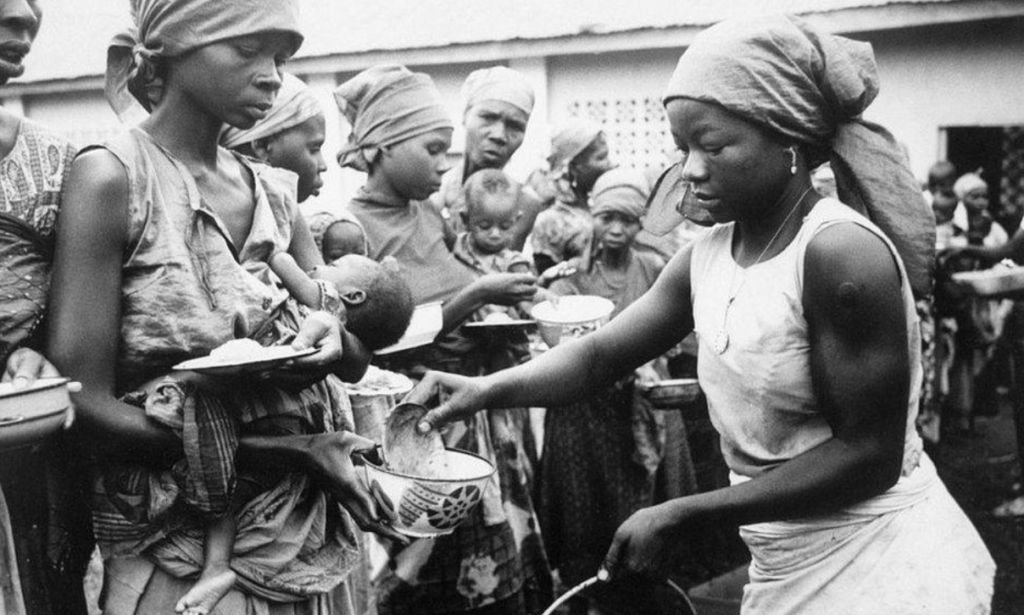
The deliberate use of starvation as a weapon of war against Biafran civilians — enforced through a naval blockade, land siege, and the systematic denial of food imports and humanitarian relief — is the defining crime of the Nigeria-Biafra War and one of the most unambiguous cases of the deliberate killing of civilians in post-World War II history. The Nigerian federal government's decision to blockade Biafra was not a byproduct of military strategy but an explicit policy: senior federal officials, including Chief Obafemi Awolowo (Federal Commissioner for Finance), stated publicly that starvation was a "legitimate weapon of war" and that the famine was an acceptable method of ending the secession. This was not an incidental consequence of military operations — it was a declared policy of mass civilian killing.
The images that emerged from Biafra — children with the distended bellies and discolored hair of kwashiorkor protein malnutrition — constituted among the most powerful and disturbing humanitarian images of the twentieth century and galvanized the modern international humanitarian aid movement, directly inspiring the founding of Médecins Sans Frontières by French doctors who had worked in Biafra and refused to accept the principle of non-interference in the face of deliberately induced mass death. Yet the same international community that was moved to found new humanitarian institutions declined to intervene in the conflict itself: Britain actively supported the Nigerian federal government, providing arms and diplomatic cover; the United States declared the war an internal Nigerian matter; and the United Nations did not act.
The scale of death from the famine dwarfed the deaths from direct combat. Conservative scholarly estimates place the total Biafran civilian death toll at approximately one million; estimates accounting for the full duration of the siege range as high as three million. The majority of those who died were children under five — a generation of Igbo and other southeastern Nigerian children killed by kwashiorkor, marasmus, and famine-related disease in what scholars including Herbert Ekwe-Ekwe have characterized as genocide: the deliberate destruction of a people through the systematic denial of the means of survival.
The international community's response to the Biafran famine was not passive neglect but active complicity in the conditions that produced it. The United Kingdom — Nigeria's former colonial power and its principal arms supplier — provided the Nigerian federal government with weapons, ammunition, and diplomatic support throughout the war, while publicly characterizing the conflict as an internal Nigerian matter in which the starvation of civilians did not constitute grounds for international intervention. British officials were informed in detail about the scale of the famine by their own diplomatic representatives and by ICRC communications; they continued supplying the federal government regardless. Harold Wilson's government calculated that British commercial interests in Nigerian oil and the stability of the Nigerian state outweighed the lives of Biafran civilians.
The Soviet Union provided MiG aircraft, Ilyushin bombers, and technical advisers that the Nigerian federal air force used to bomb Biafran civilian areas and the Uli relief airstrip, killing humanitarian workers and reducing the food reaching starving populations. Egypt provided pilots who flew these aircraft. The United States declared the conflict internal and provided no military assistance to either side, but also declined to use its diplomatic leverage to compel the federal government to permit humanitarian access. Only five countries recognized Biafra: Tanzania, Zambia, Ivory Coast, Haiti, and Gabon.
The most consequential international response to Biafra was the one that came too late and in the wrong form: the birth of the modern international humanitarian movement. French doctors who had served with the ICRC in Biafra returned to France outraged at the ICRC's commitment to confidentiality and silence in the face of mass atrocity, and founded Médecins Sans Frontières in 1971 on the explicit principle that humanitarian workers have not only a right but a duty to speak publicly about atrocities they witness. MSF today operates in over 70 countries and has served hundreds of millions of people in crisis. It is, in the most direct sense, a monument to what international silence permitted to happen in Biafra — and a commitment that it should not happen again. That same silence, in a different register, now threatens Biafran-majority communities facing contemporary jihadist pressure while the Nigerian federal government and the international community look away.
If you or your community have been affected by the events described in this report, we invite you to contribute to our documentation record.